
Click Farming: How It Works and Why It Matters

Racen Dhaouadi
March 17, 2026
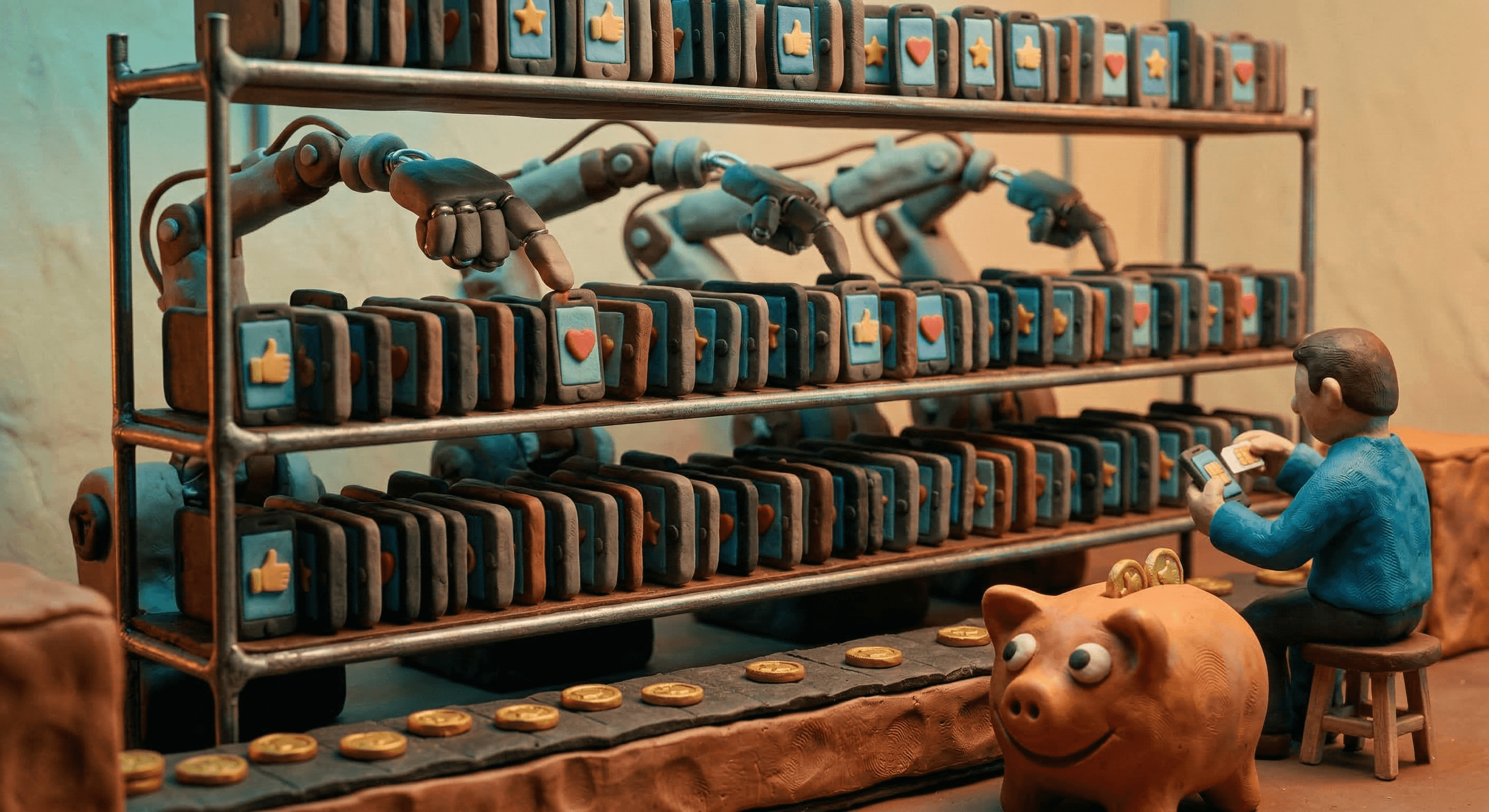
In a windowless office in Dhaka, 200 people sit in rows of plastic chairs. Each person has a phone in each hand. They tap, scroll, like, and click for 10 hours straight. They earn $3 for the day. The advertisers whose budgets they're draining will never know they exist.
Click farming is the practice of employing large groups of low-paid workers to manually click ads, like posts, or create fake engagement on demand.
It's one of the oldest and most persistent forms of ad fraud, and it's still thriving. While bot farms use software and racks of devices to automate fake activity, click farms rely on something harder to detect: real people on real devices doing real clicking. That human element is what makes click farming such a stubborn problem for advertisers and platforms alike.
The scale is significant. Click farms contribute to the estimated $84 billion lost to ad fraud annually (Juniper Research), and they operate openly in many parts of the world. Services like "buy 10,000 Instagram likes" or "boost your Google reviews" are often fronts for click farm operations.
This guide explains what click farms are, how they operate day to day, who works in them, where they're located, how they affect your business, and what you can do about it.
What Is a Click Farm?
A click farm is a business that employs hundreds of workers to manually generate fake clicks, likes, followers, reviews, and other online engagement.
The basic setup is straightforward. A room full of people, each with one or more devices, clicking through tasks assigned by a supervisor or management platform. The workers are real. The devices are real. The clicks are real. But the engagement is fake because no one behind those clicks has any genuine interest in the product, ad, or content they're interacting with.
Click farms operate as businesses. They have clients who pay for specific outcomes: 10,000 likes on an Instagram post, 500 five-star reviews on an Amazon product, 5,000 clicks on a competitor's Google Ads. The farm quotes a price, assigns the task to its workforce, and delivers the results within hours or days.
These services are sold openly. You can find click farm offerings on Telegram channels, freelance platforms like Fiverr (often disguised as "social media marketing"), and dedicated websites. Pricing is remarkably transparent: a few dollars per thousand likes, a few cents per ad click.
The key difference between a click farm and a bot farm is the human element. Bot farms rely primarily on automated software running across devices. Click farms rely primarily on human workers doing the clicking manually. In practice, many operations blend both approaches, using automation for scale and humans for tasks that require a convincing human touch.
How Do Click Farms Work?
Click farms work by assigning tasks to human workers who manually click ads, like posts, follow accounts, and write reviews across real devices.
The operation is more organized than most people expect. It runs like a factory, with shifts, supervisors, task queues, and performance tracking.
The Daily Operation
Workers arrive at the start of their shift, usually 8 to 12 hours. They sit at assigned stations, each equipped with one or more smartphones and sometimes a laptop. A supervisor or digital task board assigns the day's work: a batch of Instagram accounts to follow, a list of Google Ads to click, a set of Amazon products to review.
Workers cycle through tasks methodically. Click this ad, wait 30 seconds, scroll down, click back, move to the next. Like this post, leave a comment ("Great photo!"), follow the account, move on. The pace is steady but not rushed. Going too fast triggers platform fraud detection.
Task Distribution
Tasks flow from clients through a management layer. Some farms use custom software that distributes assignments to workers and tracks completion. Others use simpler systems: spreadsheets, WhatsApp groups, or task-management apps.
Larger operations act as intermediaries. They accept orders from resellers and marketing agencies, then distribute the work across multiple physical locations. A single client order for 50,000 Instagram likes might be split across three farms in two countries.
Account Management
Click farms maintain inventories of thousands of fake social media accounts, email addresses, and platform profiles. These accounts are created in advance, aged over weeks or months to look legitimate, and distributed across workers as needed.
Account creation itself is a task. Some workers spend their shifts doing nothing but creating new Gmail accounts, Facebook profiles, or Amazon accounts, building the supply that other workers will use for engagement tasks later.
Evasion Techniques
Sophisticated click farms use several methods to avoid detection:
- VPN rotation. Workers switch VPN connections regularly so their clicks appear to come from different locations. Some farms assign specific VPN regions to match the client's target market.
- Device switching. Workers rotate between multiple phones throughout the day so no single device generates too much activity on one platform.
- Varied timing. Rather than clicking in rapid bursts, workers space their actions over time to mimic natural engagement patterns.
- Mixed activity. Workers alternate between paid tasks and genuine personal browsing. This creates a mix of real and fake activity on each account that's harder for platforms to flag.
What Are Click Farms Used For?
Click farms are used for inflating social media metrics, committing ad click fraud, generating fake reviews, boosting app rankings, and even political manipulation.
The range of services is broader than most people realize.
Social Media Inflation
This is the largest market for click farms. Clients pay to inflate their follower counts, like counts, comment volumes, and video views on Instagram, TikTok, YouTube, Facebook, Twitter/X, and LinkedIn.
The demand comes from influencers trying to look more popular than they are, businesses trying to appear more established, and marketing agencies padding their results. Prices are low: $2-5 per thousand likes, $5-15 per thousand followers, $3-10 per thousand YouTube views.
The downstream impact hits advertisers who evaluate influencers based on engagement metrics. A brand that pays $10,000 for a sponsored post from an influencer with 500,000 followers might be reaching an audience that's 40% fake.
Ad Click Fraud
Click farms are used to commit click fraud in two ways. Competitors hire farms to click on rival ads, draining their PPC budgets. And fraudulent publishers hire farms to click on ads displayed on their own websites, inflating their ad revenue.
Because the clicks come from real humans on real devices, they're harder to catch than automated click bots. The mouse movements are natural, the timing varies, and the device fingerprints are legitimate.
Fake Reviews and Ratings
Click farms produce fake reviews at scale for Amazon products, Google Business listings, App Store apps, and review platforms like Yelp and TripAdvisor. They also produce negative reviews for competitors.
A typical package might cost $50-200 for 100 five-star Amazon reviews, each written by a different worker from a different account. The reviews are generic but passable, and they can significantly influence purchasing decisions and search rankings.
App Store Manipulation
Mobile app developers hire click farms to download and review their apps, boosting their rankings in the App Store and Google Play. Workers download the app, use it for a few minutes (to avoid detection), leave a five-star review, and move on. This artificial boost in downloads and reviews pushes the app higher in search results.
Political and Disinformation Campaigns
Click farms have been documented participating in political influence campaigns. They amplify specific content, create the appearance of grassroots support for candidates or policies, and flood comment sections with coordinated messaging. This application has drawn attention from governments and researchers worldwide.
Where Are Click Farms Located?
Click farms are concentrated in countries with low wages and weak enforcement, including Bangladesh, India, Indonesia, the Philippines, and Nepal.
The economics drive the geography. Click farming only works as a business when labor costs are low enough that the margin between what clients pay and what workers earn is substantial.
Bangladesh is widely considered the global center of click farming, particularly the capital Dhaka. Low wages ($2-4 per day for click farm work), high population density, widespread smartphone ownership, and a large young population create the perfect conditions. Multiple investigations by journalists and researchers have documented large-scale click farm operations there.
India has the second-largest click farming industry, with operations concentrated in cities like Kolkata, Delhi, and Mumbai. The English proficiency of workers is a significant advantage for tasks that require writing reviews or comments in English.
Southeast Asia is a major hub, with operations in the Philippines, Indonesia, and Vietnam. The Philippines in particular has a large English-speaking workforce that handles social media tasks for Western clients.
Growing markets include parts of Africa (Nigeria, Kenya), Central America (Honduras, Guatemala), and the Middle East. As awareness of South Asian click farms increases and platforms tighten detection in those regions, operations are spreading to new geographies.
Some click farms operate in the target market itself. A farm running out of a rented office in Miami or London can generate clicks that are geographically indistinguishable from real local traffic. These operations charge more but provide higher-quality fraud that's harder to filter based on location alone.
Who Works in Click Farms?
Click farm workers are typically young adults in low-income countries earning $1-5 per day for repetitive manual clicking, often in poor working conditions.
The workforce is mostly young, often between 18 and 30. Many are students looking for part-time income, underemployed workers who can't find other jobs, or people who stumbled into click farming through word of mouth. Recruitment happens informally: a friend tells a friend, a job listing appears on a local Facebook group, or a sign goes up near a university.
Wages vary by country and operation. In Bangladesh, workers typically earn $2-4 per day. In India, $3-5. In the Philippines, slightly more. These amounts are low by Western standards but can be competitive with other entry-level work available locally.
Working conditions range from tolerable to exploitative. Workers in organized farms sit in crowded rooms for 10-12 hour shifts, performing the same clicking motions thousands of times per day. Breaks are limited. The work is monotonous and can cause repetitive strain issues. Some operations have been compared to digital sweatshops.
Many workers don't fully understand the broader impact of what they do. They know they're clicking and liking things for money. They may not realize they're contributing to ad fraud that drains advertising budgets or manipulating elections with coordinated engagement.
It's worth noting that click farming isn't universally exploitative in the way it's sometimes portrayed. For some workers in regions with limited job opportunities, click farming provides income that wouldn't otherwise exist. The ethical picture is complicated, and the workers themselves are rarely the ones who benefit most from the fraud.
There's also a decentralized version: paid-to-click platforms and micro-task websites that recruit freelancers worldwide to complete small clicking tasks for fractions of a cent each. These workers operate from home, earn even less than farm workers, and are typically unaware they're participating in click fraud.
How Does Click Farming Affect Your Business?
Click farming wastes your ad budget on fake clicks, pollutes your analytics with fake engagement, and corrupts your marketing decisions with bad data.
The impact follows the same compounding pattern as other forms of ad fraud, but with an added difficulty: click farm traffic is harder to filter because it comes from real humans.
Wasted Ad Spend
When a click farm worker clicks your Google Ad, you pay for that click. It will never convert. If 100 click farm workers each click your ad once per day for a month at $5 per click, that's $15,000 in wasted spend. And those workers get added to your retargeting audiences, so you pay again to show follow-up ads to people who were never interested.
Corrupted Analytics
Click farm engagement inflates every metric it touches. If you're measuring campaign performance by likes, shares, or click-through rates, click farm activity makes bad campaigns look good and makes it impossible to know which content actually resonates with your real audience.
This distortion ripples through your entire marketing operation. A/B tests produce misleading results. Campaign optimizations go in the wrong direction. Budget allocation decisions are based on numbers that don't reflect reality.
Wasted Sales Resources
Click farms that target lead generation forms fill your CRM with fake leads. Your sales team spends hours chasing phone numbers that don't connect and email addresses that bounce. Lead scoring models get thrown off because the fake leads look like real engagement.
Why Click Farm Traffic Is Harder to Filter
This is the core challenge. Simple bot detection catches automated scripts because they don't behave like real browsers. But click farm workers are real people using real phones. Their mouse movements are natural. Their session timing is variable. Their device fingerprints are legitimate.
Catching click farm traffic requires looking at patterns across many sessions rather than analyzing individual sessions. The coordination, the geographic clustering, the uniform engagement quality across hundreds of sessions, these are the signals that reveal click farm activity even when each individual click looks genuine.
Want to see if click farm traffic is affecting your campaigns? Try our free traffic analyzer. No signup required.
How Can You Detect Click Farm Activity?
Detect click farm activity by monitoring for coordinated engagement patterns, geographic anomalies, low engagement quality, and session uniformity.
Individual click farm sessions look normal. The patterns only become visible when you zoom out.
Patterns to Watch For
- Engagement bursts. A sudden spike in likes, follows, or clicks that doesn't correlate with any campaign change or content event.
- Geographic clustering. Traffic or engagement concentrated in regions where your real audience doesn't exist.
- Uniform session behavior. Multiple sessions with similar time-on-site, similar scroll depth, and similar navigation patterns. Real traffic is messy and varied. Click farm traffic is suspiciously consistent.
- High volume, low quality. Lots of clicks or engagement but no downstream actions (purchases, signups, return visits).
Social Media Red Flags
If you're evaluating an influencer or your own social engagement, look for:
- Sudden follower spikes that don't correspond to any viral content or press mention
- Comments that are generic ("Nice!", "Love this!", emoji-only responses) from accounts with few posts of their own
- High follower counts but low engagement on non-promoted content
- Followers concentrated in countries that don't match the creator's audience
Ad Campaign Red Flags
For paid advertising specifically:
- CTR increases with no corresponding conversion increase
- Clicks from geographic regions you didn't target or don't normally see
- Sessions that land, stay briefly, and leave with zero interaction
- Multiple clicks from the same narrow IP ranges within short time windows
Using Detection Tools
Manual monitoring catches obvious click farming. Bot detection tools catch the sophisticated operations that blend human clicks with automation and residential proxies.
Multi-layer detection analyzes session patterns in aggregate. Even when individual sessions pass every check, coordination patterns across hundreds of sessions reveal the farm. The key is real-time analysis that flags suspicious patterns as they happen, not after the budget is already spent.
How Can You Protect Against Click Farming?
Protect against click farming with bot detection tools, geographic targeting, platform reporting, engagement quality monitoring, and ad scheduling.
Bot Detection Tools
Real-time, multi-layer bot detection is the most effective defense against click farming. These tools analyze every visitor across multiple dimensions simultaneously and flag coordinated patterns that humans reviewing dashboards would miss.
The best tools don't just look at individual sessions. They track velocity patterns (how many sessions share similar characteristics within a time window), geographic correlations, and engagement quality metrics that reveal farm activity even when each individual click comes from a real person.
For tool comparisons, see our guide to the best bot detection software in 2026.
Platform-Level Protections
Within your ad platforms:
- Tighten geographic targeting to only regions where your real customers are
- Use IP exclusion lists for known bad actors
- Monitor placement reports and exclude sites with suspicious click patterns
- Use conversion-based bidding where possible (you pay for actions, not clicks)
Engagement Quality Monitoring
Stop measuring success by clicks and likes alone. Track downstream metrics: conversion rates, time on site, pages per session, return visit rates. If a campaign shows great click numbers but terrible downstream engagement, click farming may be inflating the top of the funnel.
Make traffic quality audits a monthly habit. Compare ad traffic engagement against organic traffic. Significant gaps between the two are a warning sign.
Hyperguard detects click farm traffic in real time with multi-layer analysis. Setup takes under 5 minutes. See how it works or get started today.
What Is the Difference Between a Click Farm and a Bot Farm?
Click farms use human workers clicking manually on real devices. Bot farms use automated software on racks of devices. Many modern operations combine both approaches.
A click farm relies on people. Hundreds of workers sit in front of screens and click manually. The advantage is that the clicks genuinely come from human behavior patterns on real devices, making them harder to detect technically. The disadvantage is that humans are slower and more expensive than software.
A bot farm relies on automation. Software controls hundreds or thousands of devices simultaneously, generating fake activity at much higher volume. The advantage is scale and cost efficiency. The disadvantage is that automated activity is more detectable through technical analysis.
In reality, the distinction has blurred. Most modern operations combine both: automation handles volume, human workers handle tasks that require a convincing human touch (like writing unique review text or solving CAPTCHAs). The result is a hybrid operation that's harder to detect than either approach alone.
The defense against both is the same: multi-layer detection that looks for coordination patterns across sessions rather than trying to catch individual fake clicks.
Frequently Asked Questions
What is a click farm?
A click farm is an organized business that employs large numbers of workers to manually generate fake online engagement. Workers click ads, like social media posts, write fake reviews, and create fake accounts for clients who pay for inflated metrics. Click farms operate primarily in low-wage countries like Bangladesh, India, and the Philippines.
How much do click farm workers earn?
Click farm workers typically earn $1-5 per day depending on the country and operation. In Bangladesh, the global hub for click farming, daily wages average $2-4. Workers often sit for 10-12 hour shifts performing repetitive clicking tasks.
Is click farming illegal?
Click farming that involves ad fraud, fake reviews, or engagement manipulation is illegal in most jurisdictions under fraud, computer crime, and consumer protection laws. In the US, it can fall under the Computer Fraud and Abuse Act. However, prosecution is rare because operations are based in countries with limited enforcement and proving specific fraud is difficult.
How common is click farming?
Click farming is a significant contributor to the estimated 1 in 5 ad clicks that are fraudulent. The industry operates openly in many countries, with services sold on freelance platforms, Telegram channels, and dedicated websites. Demand continues to grow alongside digital advertising spend.
Can social media platforms detect click farms?
Major platforms like Facebook, Instagram, and YouTube have fraud detection systems that catch some click farm activity, particularly obvious patterns like sudden follower spikes or engagement from suspicious accounts. However, sophisticated click farms that use aged accounts, varied timing, and geographic rotation routinely evade platform-level detection.
How does click farming affect advertising?
Click farming wastes advertising budgets through fake ad clicks, pollutes retargeting audiences with non-human sessions, distorts attribution models by giving credit to fraudulent clicks, and corrupts analytics data that marketers use for budget allocation and campaign optimization decisions.
What is the best way to stop click farming?
The most effective defense combines multi-layer bot detection that analyzes session patterns in aggregate with platform-level protections like geographic targeting and placement exclusions. No single method is sufficient because click farm traffic comes from real humans on real devices, making individual session analysis unreliable.